UAE AI Strategy 2031: What It Means for SMEs
How small and medium-sized enterprises can leverage government incentives, funding programs, and regulatory frameworks to build AI-powered businesses.

Key Takeaways
- UAE AI Strategy 2031 aims to position the UAE as a global AI leader, with AED 50 billion allocated for AI initiatives
- SMEs can access government funding through Mohammed bin Rashid Innovation Fund, Dubai Future Accelerator, and sector-specific grants
- New regulatory frameworks provide clarity on AI ethics, data governance, and cross-border compliance
- Priority sectors include healthcare, energy, transportation, space, and technology—creating partnership opportunities
- SMEs adopting AI before 2028 qualify for accelerated licensing, tax incentives, and preferential government procurement
A Nation's Ambitious Vision
In 2017, the United Arab Emirates became the first country globally to appoint a Minister of State for Artificial Intelligence. By 2019, the government launched the UAE AI Strategy 2031—a comprehensive roadmap to transform the nation into a global AI hub. This wasn't merely aspirational; it represented a fundamental commitment to integrate AI across government, economy, and society.
For SMEs, this creates an unprecedented opportunity. While the strategy sets national goals, it simultaneously builds an ecosystem designed to support businesses of all sizes in adopting and scaling AI solutions. The government doesn't just want large corporations driving AI transformation—it explicitly recognizes that SMEs represent ninety-four percent of UAE businesses and sixty percent of the workforce, making them essential to achieving the 2031 vision.
Beyond economic metrics, the strategy carries a philosophical shift: diversifying beyond oil by building a knowledge-based economy where AI is a foundational pillar, not an afterthought. For businesses operating in or considering the UAE market, this means government alignment rather than resistance—AI adoption isn't just permitted; it's actively encouraged and financially supported.
Understanding the Strategy's Core Pillars
The UAE AI Strategy 2031 is built around eight strategic objectives, each representing areas where SMEs can find opportunity:
| Pillar | Government Objective | SME Opportunity |
|---|---|---|
| Reputation | Position UAE as global AI sandbox and testbed | Early access to regulatory frameworks, pilot programs |
| Employment | Create new AI-driven skill sets and job categories | Workforce development funding, training partnerships |
| Ecosystem | Build vibrant startup and SME community | Incubators, accelerators, government procurement preferences |
| Governance | Establish ethical AI frameworks and standards | Clear compliance pathways, certification programs |
| Funding | Mobilize public and private investment | Grants, equity-free funding, venture capital connections |
| Infrastructure | Develop world-class AI compute and data infrastructure | Cloud subsidies, data center partnerships |
| Talent | Attract global AI expertise and build local capacity | Visa fast-tracks, university partnerships, scholarship programs |
| Data | Enable secure, cross-sector data sharing | Industry-specific data lakes, API access to government datasets |
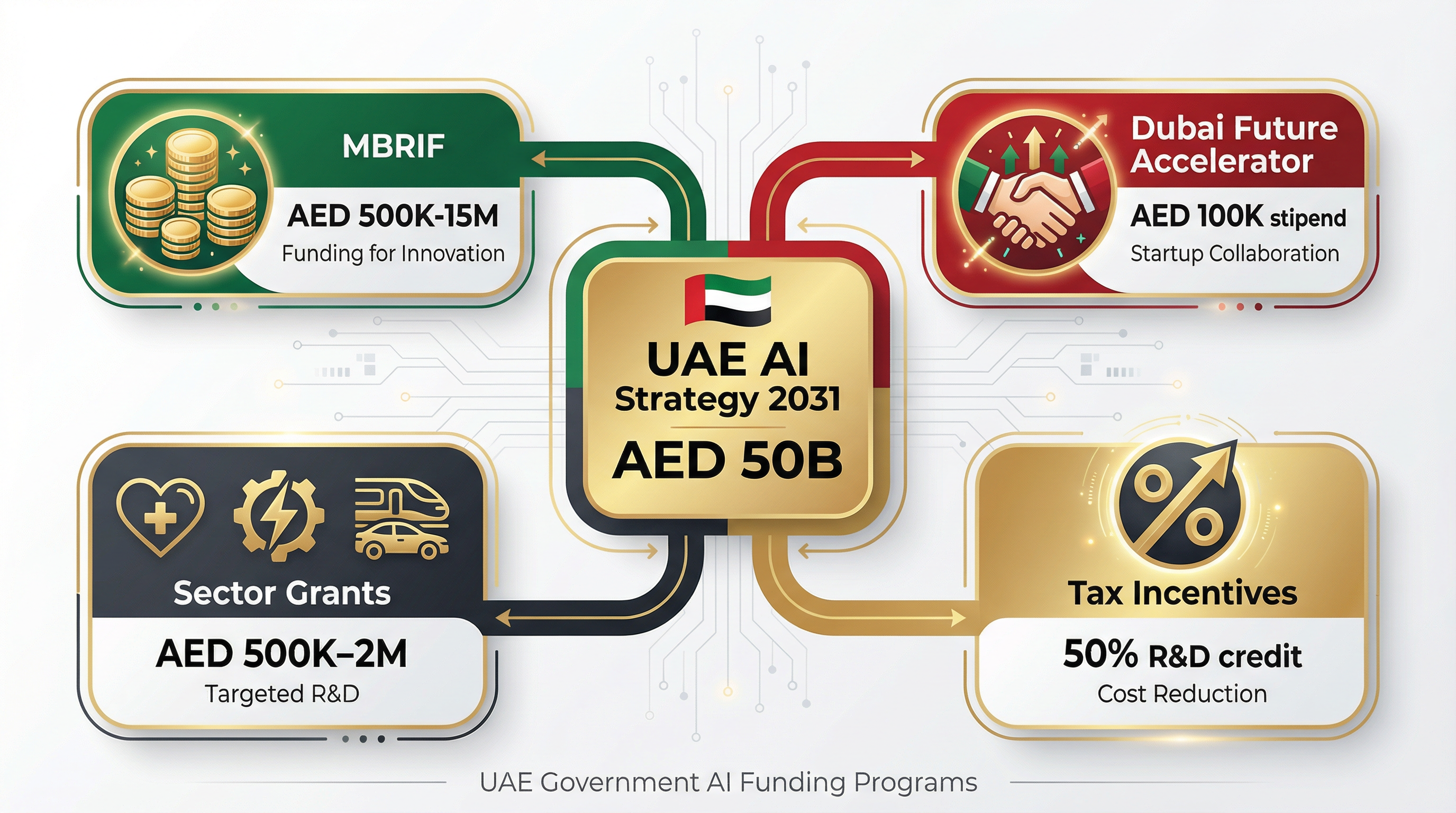
To realize these objectives, the government has allocated AED 50 billion (approximately $13.6 billion) across AI initiatives through 2031. Of this, AED 12 billion is specifically earmarked for SME-focused programs, representing the largest single allocation within the strategy.
Government Incentives for AI-Adopting SMEs
Incentives are the government's primary mechanism for encouraging AI adoption among SMEs. Unlike many countries that offer broad technology incentives, UAE programs are specifically AI-targeted and designed for practical business integration.
1. Accelerated Business Licensing
The Incentive: SMEs that meet AI adoption criteria receive expedited licensing through the "Fast-Track AI" program across all UAE emirates.
What It Means: Instead of 30-45 days for business setup and licensing, qualifying AI SMEs complete the process in 5-7 days. This applies to:
- Initial company formation
- License renewals and amendments
- Free zone and mainland coordination
- Visa processing for AI talent (15 days vs. standard 30)
Qualification Criteria:
- AI must represent ≥30% of core business operations or product offering
- Commitment to hire minimum 2 AI-related roles (data scientist, ML engineer, AI ethicist) within 6 months
- Demonstrated investment in AI infrastructure or R&D
How to Apply: Through the UAE Ministry of Economy's AI Business Portal; average approval time is 14 days.
2. Tax and Fiscal Incentives
Corporate Tax Credits: SMEs with certified AI solutions qualify for corporate tax credits:
- 2024-2026: 50% tax credit on AI R&D expenditures
- 2027-2029: 30% tax credit on AI R&D expenditures
- 2030 onward: 15% tax credit (standard innovation incentive)
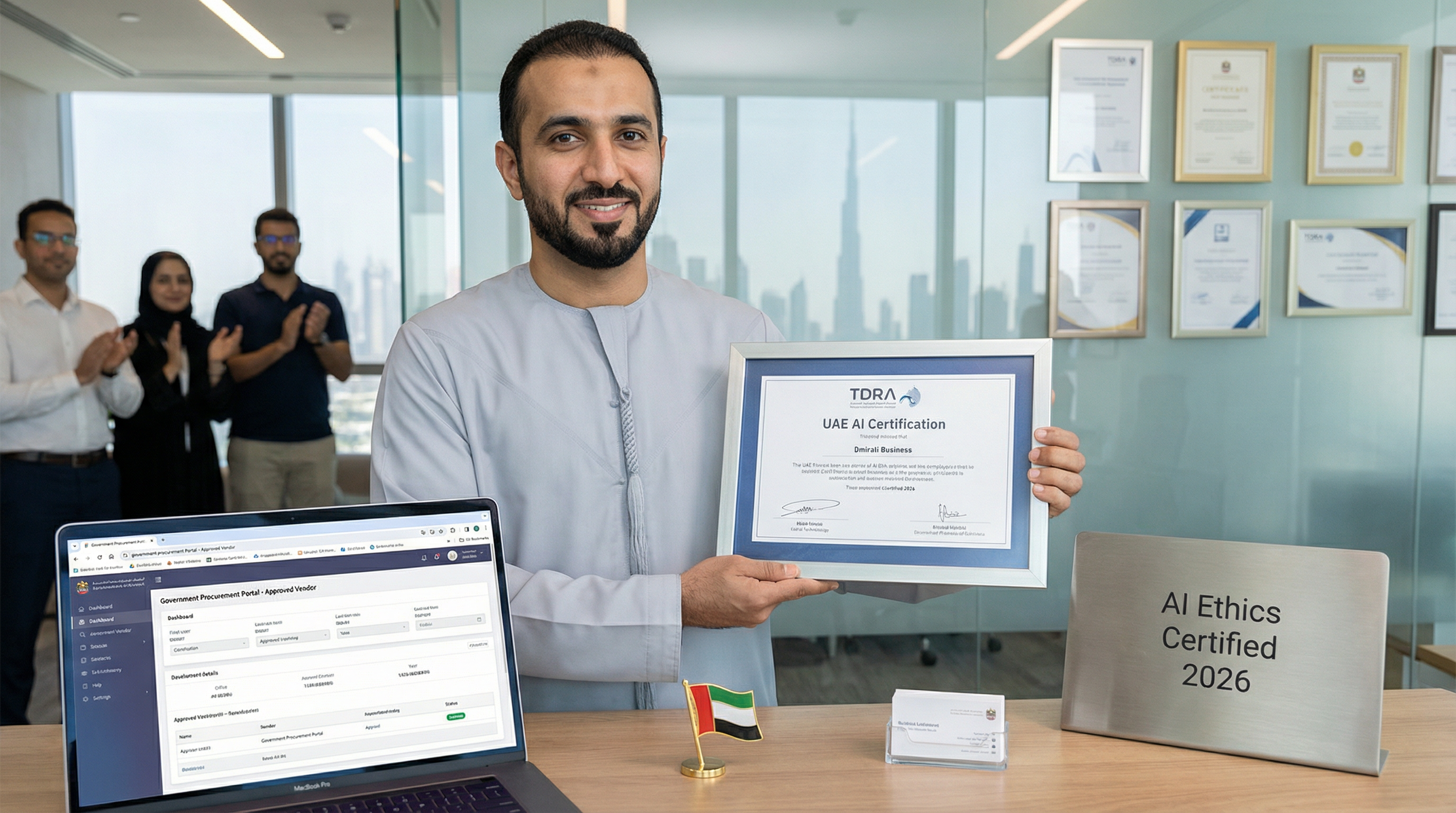
VAT Advantages: AI products and services classified as "technology innovation" under UAE VAT regulations qualify for 0% VAT on business-to-business sales within the UAE, provided the solution is certified by the Telecommunications and Digital Government Regulatory Authority (TDRA).
Customs Duty Exemptions: AI-related hardware (GPUs, servers, specialized equipment) imported for business use receive 0% customs duty. This exemption applies to:
- Direct imports for use within qualifying AI SME
- Equipment imported through approved free zones
- Temporary imports for testing and R&D purposes
3. Government Procurement Preference
The Policy: UAE federal and local government entities are required to allocate 30% of technology procurement spending to AI-certified SMEs.
What It Covers:
- AI-powered software solutions
- Algorithm development and optimization
- Computer vision and natural language processing services
- Predictive analytics and decision support systems
- AI consulting and implementation services
Practical Impact: Government procurement of technology products and services exceeds AED 40 billion annually. A 30% SME allocation represents AED 12 billion annually in potential contracts—specifically allocated to ventures that AI-certify.
How to Qualify:
- Register with the UAE Government Digital Transformation Service
- Complete AI Solutions Certification Application (TDRA)
- Demonstrate AI capabilities through case studies or proof-of-concept
- Undergo technical assessment by Ministry of Economy's AI Evaluation Committee
Timeline: Certification typically takes 8-12 weeks; once certified, SMEs are automatically added to the preferred vendor list.
4. Regulatory Sandbox Access
The Program: The UAE has established regulatory sandboxes across multiple sectors, allowing SMEs to test AI solutions in a controlled environment with temporary regulatory exemptions.
Available Sandboxes:
- Healthcare AI Sandbox (Dubai Health Authority): For medical diagnostics, patient monitoring, drug discovery AI
- Financial Services AI Sandbox (Central Bank): For fraud detection, credit scoring, robo-advisory, algorithmic trading
- Transportation AI Sandbox (RTA - Dubai Roads & Transport Authority): For autonomous vehicle systems, traffic optimization, logistics AI
- Education AI Sandbox (Ministry of Education): For personalized learning, assessment AI, educational content generation
- Government Services AI Sandbox (Digital Government): For citizen-facing AI, document processing, service optimization
Benefits for SMEs:
- Test solutions without full regulatory compliance burden
- Direct feedback from government regulators
- Faster path to commercial deployment (successful sandbox graduates receive expedited approval)
- Potential government pilot contracts (sandbox participants are prioritized for government RFPs)
Funding Programs: Capital for AI SMEs
The UAE government has recognized that capital is critical for AI adoption and has structured funding programs to address this at every stage of SME development.
Mohammed bin Rashid Innovation Fund (MBRIF)
Overview: Established in 2016, the MBRIF is the UAE's flagship innovation funding vehicle. The AI-focused track, launched in 2020, has disbursed over AED 750 million to AI SMEs.
Funding Tiers:
| Tier | Funding Amount | Equity Taken | SME Stage | Focus |
|---|---|---|---|---|
| Accelerator | AED 500K | 0% | Early-stage/Pre-revenue | Proof of concept development |
| Seed | AED 2-3M | 5-8% | Post-revenue | Product market fit, initial traction |
| Growth | AED 5-15M | 10-15% | Scaling | Market expansion, team growth |
Key Features:
- Equity-free accelerator tier: AED 500,000 convertible note that converts only if SME raises subsequent funding
- Flexible equity terms: Government takes minimal equity, prioritizing SME ownership and control
- Follow-on funding: Successful portfolio companies qualify for additional investment up to AED 30M
- Non-financial support: Mentorship, government access, market introductions
Sector Priorities (2024-2026):
- Healthcare AI
- Energy and sustainability AI
- Smart city and transportation AI
- Government services AI
Success Rate: Approximately 12% of applicants receive funding; average application-to-funding timeline is 4-5 months.
Dubai Future Accelerator (DFA)
Overview: DFA pairs SMEs with government entities to co-develop AI solutions for specific public sector challenges. It's less traditional funding and more "partnership-driven development."
How It Works:
- Challenge Identification: Government entities publish AI challenges they need solved
- SME Application: Tech companies apply with solutions to specific challenges
- Selection and Matching: SMEs are selected and paired with government partners
- 9-Week Pilot: Teams work together to build and test the solution
- Potential Procurement: Successful pilots may lead to government contracts
Funding and Support:
- Stipend: AED 100,000 per accepted team for pilot development costs
- Infrastructure: Free access to government sandbox environments and data
- Contract Potential: Average pilot-to-contract conversion rate of 35%
Sector-Specific AI Grants
Beyond broad national programs, UAE government entities offer sector-specific grants for AI initiatives:
Healthcare AI Grants (Ministry of Health & Prevention)
| Program | Amount | Purpose | Duration |
|---|---|---|---|
| Medical AI Innovation Grant | AED 1M | AI diagnostics, treatment optimization | 12-18 months |
| Telehealth AI Grant | AED 500K | Remote monitoring, AI triage | 12 months |
| Drug Discovery AI Grant | AED 2M | AI-assisted pharmaceutical research | 24 months |
Regulatory Framework: Building Trust and Compliance
A common concern for AI SMEs is regulatory uncertainty. The UAE has addressed this through comprehensive, proactive AI governance frameworks that provide clarity while enabling innovation.
UAE AI Ethics Principles and Guidelines
Published in 2020 and updated in 2024, the UAE AI Ethics Principles establish a foundation for responsible AI development and deployment. For SMEs, these are not just guidelines—they're increasingly incorporated into procurement requirements and certification criteria.
The Eight Principles:
- Fairness: AI systems must be designed and operated to avoid discriminatory outcomes and ensure equitable treatment across all demographic groups.
- Transparency and Explainability: AI systems must be understandable, with clear documentation of how decisions are made.
- Accountability: Organizations deploying AI must have clear governance structures and mechanisms for redress when harm occurs.
- Human Oversight: AI systems must be designed with appropriate human oversight, particularly in high-stakes decision-making contexts.
- Privacy and Data Governance: AI systems must comply with UAE data protection regulations and implement robust data governance practices.
- Security and Robustness: AI systems must be resilient to attacks, errors, and unintended behavior.
- Social and Environmental Responsibility: AI development must consider broader societal impacts and environmental sustainability.
- Reliability and Safety: AI systems must function consistently as intended under expected conditions and fail safely when they don't.
AI Certification Program
Overview: Launched in 2023, the UAE AI Certification Program provides a formal process for SMEs to demonstrate their AI systems comply with national ethics and governance standards.
| Level | Focus | Requirement | Validity |
|---|---|---|---|
| Basic | Fundamental ethics compliance | Self-assessment + documentation review | 2 years |
| Standard | Technical compliance + risk assessment | Independent audit + technical testing | 2 years |
| Advanced | Full governance + continuous improvement | Ongoing monitoring + annual re-certification | 1 year |
Benefits of Certification:
- Mandatory for government procurement: All AI solutions sold to government entities must be certified
- Procurement preference: Many private sector companies require certification in their vendor selection process
- Reduced liability: Certification provides defense against claims of negligence in AI deployment
- Consumer trust: Certification can be used in marketing to demonstrate responsible AI practices
Cost and Timeline:
- Basic: AED 15,000, 6-8 weeks
- Standard: AED 45,000, 12-16 weeks
- Advanced: AED 120,000, 20-24 weeks
Practical Opportunities: Where SMEs Can Succeed
Beyond incentives, funding, and frameworks, the UAE AI Strategy 2031 creates specific market opportunities that SMEs can pursue. These aren't speculative—they're emerging now, with government entities actively seeking solutions.
Opportunity 1: Government AI Readiness Assessment and Implementation
The Need: Government entities across the UAE are mandated to assess their AI readiness and implement AI solutions across operations. Most lack internal AI expertise and seek external partners.
What SMEs Can Provide:
- AI Readiness Assessments: Evaluate organizational data, infrastructure, processes, and workforce capabilities to identify AI opportunities
- AI Implementation Roadmaps: Develop phased AI adoption plans aligned with entity objectives and UAE AI Strategy requirements
- Pilot Implementation: Execute initial AI projects to demonstrate value
- Change Management: Train government staff on AI adoption and governance
Market Size: AED 3-5 billion annually in consulting and implementation services across federal, emirate, and local government entities.
Opportunity 2: Sector-Specific AI Solutions
The UAE AI Strategy prioritizes specific sectors for AI adoption. SMEs developing solutions for these sectors have tailwinds from government policy.
Healthcare
Priority Areas:
- Medical diagnostics AI (radiology, pathology, ophthalmology)
- Predictive analytics for patient outcome and resource optimization
- Drug discovery and development AI
- Personalized medicine and treatment recommendation
- Telehealth and remote monitoring AI
Energy and Sustainability
Priority Areas:
- Smart grid optimization and demand forecasting
- Renewable energy efficiency (solar, wind)
- Carbon capture and emissions monitoring AI
- Predictive maintenance for energy infrastructure
- Oil & gas optimization (exploration, production, refining)
Transportation and Logistics
Priority Areas:
- Autonomous vehicle systems and components
- Traffic flow optimization and predictive congestion management
- Smart logistics and supply chain optimization
- Fleet management and predictive maintenance
- Mobility-as-a-Service (MaaS) platforms
A Step-by-Step Guide for SMEs
Step 1: Assess Your AI Readiness (Weeks 1-2)
Questions to Consider:
- How does AI intersect with your current or planned business?
- What AI capabilities do you have in-house or need to acquire?
- What data do you have that could fuel AI solutions?
- Which UAE AI Strategy priority sectors align with your business?
Action Items:
- Complete the UAE AI Readiness Self-Assessment (available through Ministry of Economy)
- Identify 2-3 specific AI opportunities aligned with UAE priorities
- Map your current capabilities against these opportunities
- Conduct a preliminary competitive analysis of other SMEs in your target area
Step 2: Leverage Government Resources for Learning (Weeks 3-4)
Action Items:
- Create a learning plan focused on skills relevant to your AI opportunity
- Complete AI ethics and governance modules (required for certification)
- Attend at least one government-organized AI workshop or networking event
- Identify key contacts in relevant government entities
Step 3: Develop Your AI Solution or Service (Weeks 5-12)
Key Considerations:
- Design with government procurement requirements in mind (certification, documentation, security)
- Consider data requirements and how you'll access necessary training data
- Plan for regulatory compliance from day one, not as an afterthought
- Build flexibility to adapt to evolving UAE AI regulations
Step 4: Pursue AI Certification (Weeks 13-20)
Certification Path:
- Documentation Preparation: Compile evidence of compliance with UAE AI Ethics Principles
- Self-Assessment: Complete the Basic Certification self-assessment
- Submit Application: Apply for AI Certification through TDRA or accredited certifier
- Certification Assessment: Undergo review and potential audit
- Receive Certification: Obtain Basic or Standard certification
Budget Considerations:
- Basic Certification: AED 15,000
- Standard Certification: AED 45,000
- Additional costs for auditor preparation if using external consultant: AED 25,000-50,000
Step 5: Access Funding and Support Programs (Weeks 13-24)
Funding Applications to Pursue:
- Mohammed bin Rashid Innovation Fund: Prepare application for accelerator or seed funding
- Sector-Specific Grants: Apply for relevant sector grants aligned with your AI solution
- Dubai Future Accelerator: Identify relevant challenges and prepare application
- Private VC Matching: If pursuing private funding, prepare ADIO matching fund application
Step 6: Secure Government Partnerships and Contracts (Months 6-12+)
Market Entry Strategy:
- Start Small: Pursue pilot projects or smaller contracts to build track record
- Leverage Sandbox Access: Use regulatory sandboxes to demonstrate solution effectiveness
- Partner with Larger Integrators: Collaborate with established government vendors
- Focus on Priority Sectors: Emphasize alignment with UAE AI 2031 priority sectors in proposals
Common Challenges and How to Overcome Them
Challenge 1: Navigating Government Processes
Problem: Government processes for incentives, funding, and procurement can be complex and time-consuming, particularly for SMEs unfamiliar with UAE government systems.
Solution:
- Start with single points of entry rather than pursuing all opportunities simultaneously
- Consider partnering with a government relations consultant for initial engagement
- Leverage business councils and chambers of commerce for support
- Attend government-organized orientation sessions and workshops
Challenge 2: Data Access for AI Development
Problem: High-quality, relevant data is critical for AI development, but accessing real-world data can be challenging.
Solution:
- Leverage government data exchange initiatives
- Build partnerships with government entities or private companies who have data access
- Use synthetic data generation techniques
- Start with publicly available datasets to demonstrate capabilities
Challenge 3: Building Technical AI Capability
Problem: Developing in-house AI expertise requires significant investment in recruiting and training.
Solution:
- Focus on domain-specific AI capability rather than general AI expertise
- Leverage AI-as-a-Service platforms rather than building everything from scratch
- Partner with universities to access AI talent
- Consider hiring remote AI talent globally, then use UAE's visa fast-track programs
Conclusion: The Window of Opportunity
The UAE AI Strategy 2031 represents a once-in-a-generation opportunity for SMEs. Most countries talk about AI as important. The UAE is backing it with AED 50 billion in funding, comprehensive regulatory frameworks, procurement preferences, and a clear mandate across government.
For SMEs currently operating in the AI space, the UAE offers immediate opportunities to scale, access funding, and secure government contracts. For SMEs considering AI expansion, the UAE provides a supportive ecosystem with clear pathways to market.
The window of opportunity won't remain open indefinitely. As the ecosystem matures, competition will increase, and the competitive advantage of early movers will diminish. SMEs entering the UAE AI market in 2026-2027 still have significant first-mover advantages, but those who wait until 2029+ will face a more crowded, competitive landscape.
The question for SME leaders isn't whether the UAE AI ecosystem is real—it is. The question is whether you'll seize the opportunity while it's still open.
Your next step is identifying which aspect of the UAE AI ecosystem aligns with your business strengths and objectives. Whether that's applying for the MBRIF accelerator, entering a regulatory sandbox, pursuing AI certification, or contacting a government entity about partnership, the path is clear. The ecosystem is ready. The question is whether you're ready to engage.
Quick-Start Action Checklist
Ready to engage with the UAE AI ecosystem? Here's your first 30 days:
Week 1: Foundation
- ☐ Review the UAE AI Strategy 2031 official documentation
- ☐ Complete the UAE AI Readiness Self-Assessment
- ☐ Register on the UAE AI Business Portal
- ☐ Identify 2-3 AI opportunities aligned with your business
Week 2: Learning and Networking
- ☐ Complete AI Ethics and Governance training modules
- ☐ Register for an upcoming AI-focused government workshop
- ☐ Identify key contacts in relevant government entities
- ☐ Join relevant AI and technology business councils
Week 3: Solution Development
- ☐ Map your solution or service to UAE AI Strategy priorities
- ☐ Begin documenting evidence of AI ethics compliance
- ☐ Identify potential government partners for pilot projects
- ☐ Start preparation for AI certification application
Week 4: Initial Engagement
- ☐ Submit AI certification application (Basic level)
- ☐ Identify and prepare for relevant funding program application
- ☐ Reach out to identified government partners about collaboration
- ☐ Register for the next Dubai Future Accelerator application cycle
Frequently Asked Questions
Do I need to be a UAE national to access AI funding programs?
No. Most UAE AI funding programs are open to all businesses registered in the UAE, regardless of founder nationality. However, some programs offer additional benefits for UAE nationals or businesses with significant local content (Emirati employees, local partnerships).
How long does it take to get AI certification?
Basic certification typically takes 6-8 weeks from application to approval. Standard certification takes 12-16 weeks. Advanced certification requires 20-24 weeks. Timeline depends on the completeness of your documentation and whether any remediation is required after initial assessment.
Can I apply for multiple funding programs simultaneously?
Yes. You can apply to multiple programs (MBRIF, sector grants, Dubai Future Accelerator) simultaneously. Rejection from one doesn't preclude acceptance from another. In fact, applying to multiple programs increases your chances of securing funding.
What if my AI solution doesn't fit into a priority sector?
While priority sectors receive enhanced support, the UAE AI Strategy is comprehensive. General AI solutions can still access funding through MBRIF, regulatory sandboxes, and tax incentives. Focus on demonstrating clear business value and alignment with broader UAE AI Strategy objectives (e.g., employment, ecosystem development).
Do I need to have an AI solution already built to apply for funding?
Not necessarily. MBRIF Accelerator tier specifically targets early-stage companies with proof-of-concept ideas rather than fully built solutions. However, you do need a clear technical specification, market validation evidence, and a credible team. The more developed your solution, the higher funding tiers you can access.
Government Program Disclaimer
This article provides independent analysis of UAE government AI programs and initiatives. The author has no official relationship with the UAE government, Ministry of Economy, TDRA, MBRIF, Dubai Future Accelerator, or any other government entities mentioned. Information presented is based on publicly available government documentation, program guidelines, and industry research current as of February 2026. Program details, funding amounts, eligibility criteria, and timelines are subject to change. Readers should verify current program specifications directly with relevant government entities before making business decisions or submitting applications.
Related Articles
Top 5 AI Tools for Dubai SMEs in 2026
Discover the most effective, affordable AI platforms that Dubai small businesses are using to automate operations.
No-Code AI: Why SMEs Don't Need Developers
Build powerful AI solutions without coding. Complete guide to no-code platforms for Dubai SMEs.