
How AI Personalization Works for Retail
AI-powered personalization systems use machine learning algorithms to analyze customer behavior, purchase history, browsing patterns, and demographics to deliver tailored recommendations and experiences across every touchpoint. These systems operate in real time, adjusting recommendations and content based on each customer's interactions.
For example, a customer browsing a Dubai fashion retailer's website might receive product recommendations based on:
- Previous purchases in similar categories
- Items added to cart but not purchased
- Browsing behavior during current session
- Demographic patterns from similar customer profiles
- Seasonal trends relevant to their location
This personalization extends beyond product recommendations. AI can optimize email marketing send times for maximum engagement, adjust website layouts to highlight relevant categories, and even personalize pricing and promotions for high-value customers. The system continuously learns from each interaction, improving recommendations over time.
The key for budget-conscious retailers is that modern AI solutions don't require custom development. Platforms integrate seamlessly with existing e-commerce platforms (Shopify, WooCommerce, Magento, custom solutions), requiring minimal technical expertise to deploy and manage.
Challenges for Budget-Conscious Retailers
Middle East retailers face specific pressures that make personalization both critical and challenging to implement affordably. Understanding these constraints helps identify the right approach.
Limited Technical Resources
Many Dubai SMEs operate with lean technical teams—sometimes just one IT manager handling everything from POS systems to website maintenance. Complex personalization solutions requiring engineering resources simply aren't feasible. This constraint directs retailers toward plug-and-play solutions with minimal ongoing technical requirements.
Multi-Channel Complexity
Dubai retailers often operate across multiple channels: physical stores, e-commerce websites, Instagram storefronts, and marketplaces like Noon and Amazon.ae. Personalization that works seamlessly across these channels has traditionally required expensive custom integrations. Budget retailers struggle with fragmented customer data and inconsistent experiences across touchpoints.
Seasonality and Fast Trends
Dubai's retail environment is heavily influenced by seasons—Ramadan, summer sales, Expo events, school holidays, and tourism peaks. Personalization systems need to adapt quickly to these seasonal shifts and fast-moving trends. Rigid, expensive systems often struggle with this agility, while smaller, more nimble solutions can adapt faster.
What Makes AI Personalization Affordable?
Modern AI personalization solutions have become accessible to smaller retailers through new technologies, pricing models, and implementation approaches. The key is understanding which capabilities deliver the most value for the investment.
Cloud-Based SaaS Models
The shift from on-premise enterprise software to cloud-based SaaS platforms has dramatically lowered entry barriers. Instead of upfront investments of hundreds of thousands of dirhams in hardware and software licenses, retailers pay predictable monthly subscriptions. These platforms include hosting, maintenance, updates, and security—eliminating ongoing IT overhead.
A Dubai boutique retailer can access sophisticated personalization capabilities for AED 2,000-4,000 monthly—a fraction of traditional implementation costs while receiving enterprise-level features and ongoing improvements as vendor algorithms evolve.
Pre-Built Integrations
The most cost-effective solutions offer pre-built integrations with popular platforms. A retailer using Shopify can activate personalization through apps that connect with just a few clicks. This eliminates expensive custom development work and reduces implementation timelines from months to weeks.
One Dubai home décor retailer deployed basic product recommendations on their Shopify store in five days using a pre-built integration, seeing an 18% increase in average order value within the first month.
Modular Implementation
Rather than implementing comprehensive personalization across all channels simultaneously, budget-conscious retailers can start with high-impact use cases and expand gradually. Common starting points include:
- Product recommendations on product pages—highest impact, lowest complexity
- Exit-intent popups with personalized offers—recovers abandoned carts
- Email product recommendations—increases repeat purchase rates
- Homepage personalization for returning visitors—improves engagement
This modular approach spreads costs over time and allows retailers to validate ROI before expanding implementation.
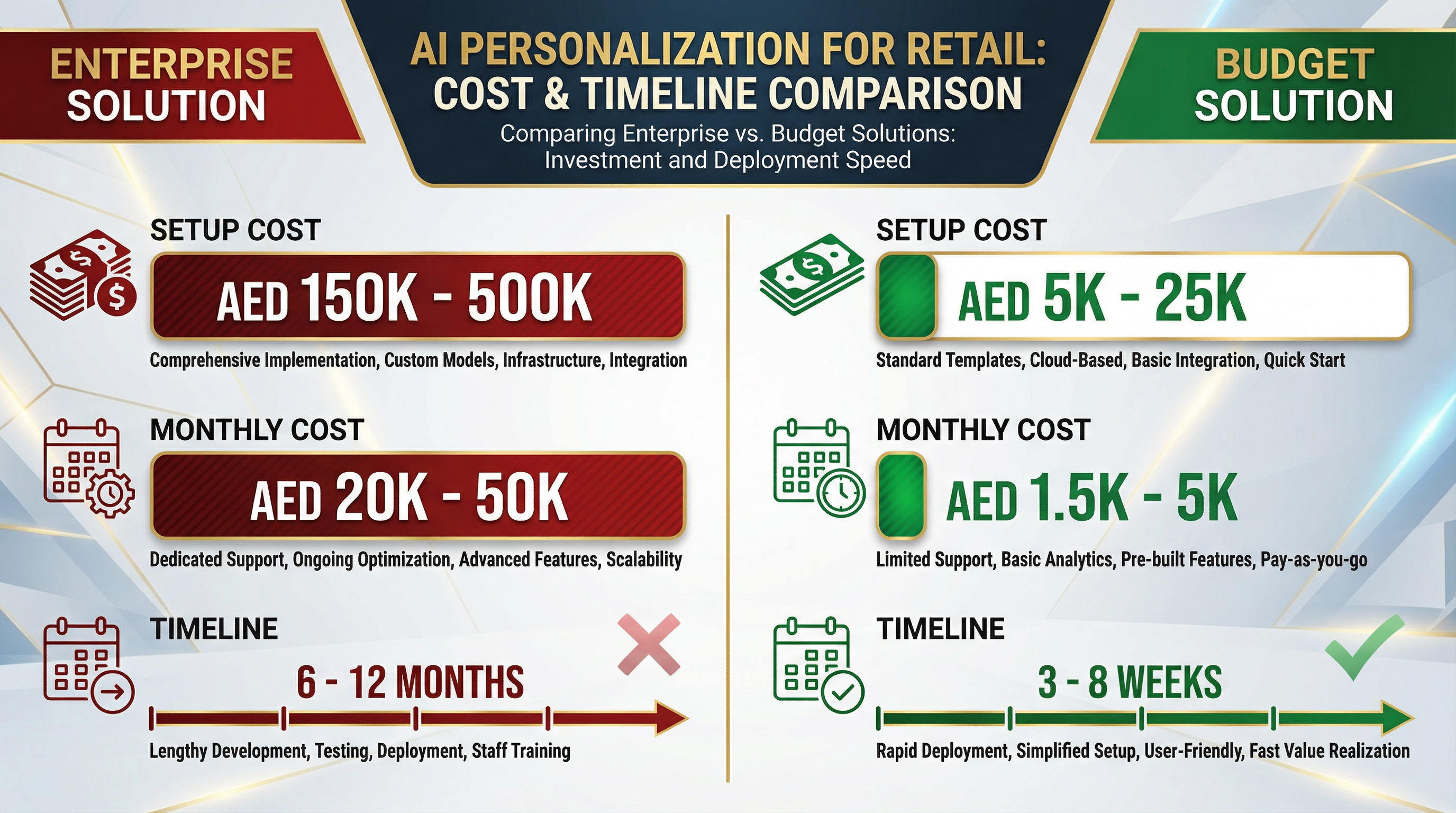
Cost Comparison: Enterprise vs. Budget Personalization
The financial difference between traditional enterprise personalization and modern budget-friendly solutions is substantial. Smaller retailers need to understand where their money goes and which investments deliver the most value.
Implementation Cost Breakdown
| Cost Category | Enterprise Solution | Budget Solution |
|---|---|---|
| Setup/Implementation | AED 150,000-500,000 | AED 5,000-25,000 |
| Monthly Software | AED 20,000-50,000 | AED 1,500-5,000 |
| Custom Development | AED 75,000-200,000 | Minimal (pre-built) |
| IT Staff Requirements | 2-3 dedicated staff | 0-0.5 FTE oversight |
| Timeline to Value | 6-12 months | 3-8 weeks |
| Upgrades & Maintenance | Included (high cost) | Included (low cost) |
ROI Case Study: Dubai Fashion Boutique
A mid-sized fashion retailer in Dubai Mall implemented budget AI personalization with the following results:
Month 1-2: Initial implementation focusing on product page recommendations
- Investment: AED 12,000 (setup) + AED 2,500/month
- Results: 12% increase in average order value
Month 3-4: Added personalized email recommendations
- Investment: AED 800 (email integration) + existing monthly fee
- Results: 28% increase in email click-through rate, 22% higher email conversion
Month 5-6: Implemented homepage personalization for returning customers
- Investment: AED 1,500 (setup)
- Results: 35% increase in return customer conversion rate
6-Month Results:
- Total investment: AED 34,300
- Total incremental revenue: AED 156,000
- 6-month ROI: 354%
- Payback period: 5 weeks
Ready to Explore Personalization for Your Retail Business?
Get a customized roadmap for budget-friendly AI implementation tailored to your store, product catalog, and customer base.
Implementation Steps for Budget-Conscious Retailers
Successful personalization implementation on a budget requires strategic prioritization and disciplined execution. Retailers who rush into comprehensive deployments often waste money and fail to achieve meaningful results.
Phase 1: Audit and Set Priorities (Week 1-2)
Before selecting technology, understand your starting point and highest-impact opportunities:
- Data audit: What customer data do you currently collect? What data are you missing?
- Channel analysis: Which channels drive the most revenue? Where are the biggest drop-off points?
- Customer segmentation: What are your most valuable customer segments? What behaviors distinguish them?
- Technical assessment: What e-commerce platform do you use? What existing tools and integrations can you leverage?
A Dubai electronics retailer discovered through this audit that 60% of revenue came from just 30% of customers who made repeat purchases within 90 days. This insight shaped their personalization strategy to focus on retention rather than acquisition.
Phase 2: Select High-Value Use Cases (Week 2-3)
Choose 2-3 personalization use cases that offer the clearest ROI path. Common high-impact starting points for budget retailers:
Cross-Sell/Up-Sell on Product Pages
- Implementation complexity: Low
- Typical impact: 10-20% AOV increase
- Example: Customer viewing a smartphone receives accessories recommended in a "frequently bought together" section
Abandoned Cart Recovery
- Implementation complexity: Low (often built into platforms)
- Typical impact: 5-15% recovery of abandoned carts
- Example: Exit-intent popup offering 5% discount for completing purchase
Post-Purchase Recommendations
- Implementation complexity: Low
- Typical impact: 15-25% increase in second purchase rate
- Example: Email sent 7 days after purchase with relevant complementary products
Phase 3: Choose and Deploy Solution (Week 3-6)
Select a solution that aligns with your platform and budget. Key criteria to evaluate:
- Platform compatibility: Does it integrate with your e-commerce platform?
- Implementation timeline: Can it be deployed without custom development?
- Pricing model: Monthly subscription vs. transaction-based pricing?
- Support quality: What level of support is included during initial implementation?
- Exit options: Can you export your data and customer models if you switch providers?
For Shopify retailers, popular budget-friendly options include LimeSpot, Nosto, and Nextopia. For WooCommerce, YITH and Beeketing offer cost-effective entry points. Custom solutions often work with AI personalization APIs from AWS Personalize, Google Recommendations AI, or Algolia.
Phase 4: Launch and Measure (Week 6+)
Start with a soft launch to a portion of traffic to validate results before full rollout:
- A/B test implementation: Run personalization for 20-30% of traffic while maintaining standard experience for control group
- Monitor key metrics: Track average order value, conversion rate, revenue per session, and return customer rate
- Gather customer feedback: Monitor for any negative reactions to personalized experiences
- Iterate and optimize: Adjust algorithms and content rules based on performance data
One Dubai children's toy retailer initially showed overly aggressive discount recommendations, training customers to wait for promotions. By adjusting their algorithm to highlight full-price items first and using discounts strategically, they improved margins by 8 points while maintaining recommendation performance.

Common Pitfalls to Avoid
Budget-conscious retailers often make avoidable mistakes that waste money or undermine personalization effectiveness. Avoiding these pitfalls preserves investment and accelerates time to value.
Over-Personalization Risk
Showing different experiences to every customer can create confusion and technical overhead. Focus on 3-5 meaningful customer segments rather than attempting true 1:1 personalization initially. A Dubai gift retailer simplified from 12 user segments to 4 and saw better results due to cleaner data and easier campaign management.
Ignoring Privacy Expectations
UAE customers have growing privacy concerns. Transparent communication about data use, clear opt-out options, and avoiding creepy-level personalization builds trust. Always provide value in exchange for data collection—don't just collect for collection's sake.
Neglecting Data Hygiene
Poor quality data produces poor quality recommendations. Invest in ongoing data cleaning and validation. One Dubai cosmetics retailer eliminated 30% of customer records due to obvious errors and outdated information, which significantly improved recommendation accuracy and reduced database costs.
Measuring the Wrong Metrics
Vanity metrics like click-through rates on recommendations don't necessarily translate to revenue. Focus on business outcomes: average order value, customer lifetime value, repeat purchase rate, and overall revenue impact. A Dubai jewelry retailer initially celebrated high recommendation click rates but discovered they weren't converting—adjusting their algorithm to focus on conversion rather than clicks improved revenue by 22%.
Calculate Your Personalization ROI
Use our free calculator to estimate the potential revenue impact and payback period for AI personalization in your retail business.
The Strategic Advantage for SME Retailers
Small and medium retailers actually have advantages over large enterprises when implementing personalization. These advantages, when leveraged correctly, can enable faster implementation and better customer relationships.
Closer Customer Relationships
SME retailers often have deeper understanding of their customer base and more direct relationships. This qualitative insight can complement AI-driven recommendations, creating hybrid personalization that feels authentic rather than algorithmic. A Dubai artisan furniture store combines purchase history with staff insights about customer preferences, creating recommendations that customers describe as feeling "truly understood."
Faster Decision-Making
Small teams can implement, test, and iterate personalization strategies without corporate approval processes. A boutique fashion retailer tested and refined their recommendation algorithm across 8 iterations in 6 weeks—something that would take months in a large enterprise.
Niche Domain Expertise
Specialized retailers understand their product categories deeply and can encode this knowledge into personalization rules. A Dubai sporting goods retailer created custom recommendation logic for cricket equipment that outperformed general-purpose algorithms, leveraging their expertise about complementary products and skill progression.
Conclusion
AI-powered personalization is no longer the exclusive domain of global retailers with enterprise budgets. Cloud-based platforms, pre-built integrations, and modular implementation strategies have democratized access to sophisticated recommendation and personalization capabilities.
Dubai and UAE retailers implementing budget-friendly AI personalization report 15-25% increases in average order value, 20-35% improvements in customer retention, and 4-8 month payback periods. The technology delivers measurable results while enhancing customer experiences and building competitive advantage.
The key is starting strategically—with clear objectives, prioritized use cases, and disciplined measurement—rather than attempting comprehensive deployment from day one. Retailers who take this approach build personalization capabilities that scale with their business and deliver compounding returns over time.
Ready to Explore Personalization for Your Retail Business?
Book your free consultation to get a customized roadmap for budget-friendly AI implementation.
Frequently Asked Questions
Q: What is the minimum monthly investment for AI personalization for a small retailer?
A: Budget-friendly solutions typically start around AED 1,500-3,000 monthly for basic product recommendations. More comprehensive solutions with multi-channel capabilities range from AED 3,000-8,000 monthly. Many retailers see positive ROI within the first 2-3 months.
Q: Can personalization work for retailers with small product catalogs?
A: Yes, personalization can be especially valuable for smaller catalogs. With fewer products to choose from, recommendations can help customers discover relevant items they might miss browsing independently. Small-catalog retailers often see higher conversion rates from recommendations because each recommendation represents a larger percentage of their inventory.
Q: Do I need a dedicated data analyst to manage AI personalization?
A: Most modern SaaS personalization platforms are designed to be managed by marketing or e-commerce teams rather than data scientists. Training and ongoing optimization typically require 2-5 hours monthly initially, decreasing to 1-2 hours as the system learns your business.
Q: How does personalization work across physical stores and online channels?
A: True omnichannel personalization requires integrating data across channels, starting with email (e.g., capture customer email at checkout in-store) and building from there. Some retailers use loyalty programs as their primary data bridge, while others implement simple solutions like personalized email recommendations based on in-store purchase history.
Q: Will customers find AI personalization intrusive or creepy?
A: Personalization becomes intrusive when it's opaque, uses sensitive data improperly, or seems invasive. The key is transparency (let customers know why they're seeing recommendations), value focus (ensure recommendations help rather than just sell), and control (provide easy opt-out options). Most customers appreciate relevant recommendations when they're based on obvious shopping behavior.
Q: How long does it take to see results from personalization implementation?
A: Basic product recommendations typically show impact within 2-4 weeks. More sophisticated personalization across multiple channels takes 2-3 months to reach optimal performance as the algorithm accumulates customer data and learns patterns in your business.
Third-Party Disclaimer: This article references third-party platforms and tools (LimeSpot, Nosto, Nextopia, YITH, Beeketing, AWS Personalize, Google Recommendations AI, Algolia, Shopify, WooCommerce, Magento, Noon, Amazon.ae) for informational purposes only. BTW.CONSULTING is not affiliated with, endorsed by, or sponsored by these companies. Pricing, features, and availability are subject to change. Always conduct your own due diligence before selecting any technology solution.